Cyhexatin
Also known as TCHH, Dowco-213, ENT 27,395-X
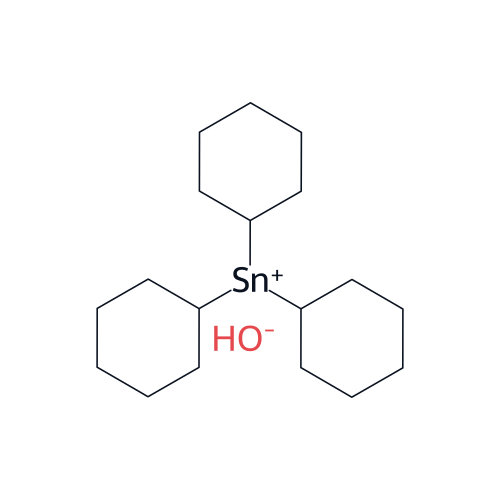
Key facts
What buyers check first
- Appearance
- White crystalline powder
- Melting point
- 196 °C
- Boiling point
- 227.8 °C
- Solubility
- In water <1 mg/l (25 °C)
- HS code
- 293120
- Category
- Insecticides and acaricides
- UN number
- UN 2811

What is Cyhexatin?
Plain description, key identifiers and synonyms
Technical cyhexatin is a nearly odorless white crystalline powder that has no true melting point but degrades to bis(tricyclohexyl)tin oxide at 121 to 131 °C which decomposes at 228 °C, a melting point of 195-198 °C is also reported. Very insoluble in water (less than 1 mg/L at 25 °C), but wettable by water. Soluble in some organic solvents (acetone 1.3 g/L, xylenes 3.6 g/L, carbon tetrachloride 28 g/L, dichloromethane 34 g/L). Used as an acaricide (an agent to kill plant-feeding mites) in almonds, walnuts, hops and some fruits.
Cyhexatin is an organotin insecticide.
Identifiers
Registry numbers, names and line notations, tap to copy
- IUPAC name
- tricyclohexylstannanylium hydroxide
- CAS number
- 13121-70-5 CAS number cross-checked
- EC number
- 236-049-1
- Molecular formula
- C18H34OSn
- InChIKey
- WCMMILVIRZAPLE-UHFFFAOYSA-M
- InChI
- InChI=1S/3C6H11.H2O.Sn/c3*1-2-4-6-5-3-1;;/h3*1H,2-6H2;1H2;/q;;;;+1/p-1
- SMILES (canonical and isomeric)
- C1CCC(CC1)[Sn+](C2CCCCC2)C3CCCCC3.[OH-]
Synonyms
- TCHH
- Dowco-213
- ENT 27,395-X
- ENT 27395
- Hydroxytricyclohexylstannane
- Ortho Plictran 50 wettable miticide
- Plictran
- Plictran 5OW miticide
- Plyctran
- Stannane, tricyclohexylhydroxy-
- TCTH
- Tin, tricyclohexylhydroxy-
- Tricyclohexylhydroxystannane
- Tricyclohexylhydroxytin
- Tricyclohexylstannanol
- Tricyclohexylstannium hydroxide
- Tricyclohexyltin hydroxide
- Tricyclohexylzinnhydroxid
- tricyclohexylstannanylium, hydroxide
Physical and chemical properties
Measured values and descriptors computed from the structure
Physical and chemical properties
Measured values, check the supplier specification for your grade
| Appearance | White crystalline powderexp.Measured value |
|---|---|
| Odour | Nearly odorlessexp.Measured value |
| Melting point | 196 °Cexp.Measured value |
| Boiling point | 227.8 °Cexp.Measured value |
| Solubility | In water <1 mg/l (25 °C)exp.Measured value |
| Vapour pressure | Negligible (25 °C)exp.Measured value |
Values vary by grade. Ask suppliers for the COA or TDS of the batch you buy.
Computed descriptors
Calculated from the structure, useful for screening and formulation
| Molecular weight | 385.18 g/molcalc.Computed value |
|---|---|
| Exact mass | 386.1632 Dacalc.Computed value |
| LogP (octanol/water) | 6.31calc.Computed value |
| Topological polar surface area | 30 Ųcalc.Computed value |
| Hydrogen bond donors | 0calc.Computed value |
| Hydrogen bond acceptors | 1calc.Computed value |
| Rotatable bonds | 3calc.Computed value |
| Heavy atoms | 20calc.Computed value |
| Rings | 3calc.Computed value |
| Aromatic rings | 0calc.Computed value |
| Fraction sp3 carbons | 1calc.Computed value |
| Formal charge | 0calc.Computed value |
| Stereocentres | 0calc.Computed value |
| Components | 2calc.Computed value |
| Lipinski rule of five | Passes (1 violation)calc.Computed value |
Calculated for screening. Confirm critical figures with the supplier.
Murcko scaffold
The ring system that remains when every side chain is removed
[CH]2CCCCC2)CC1](/scaffold/WSSWKXSQIKBUQR-UHFFFAOYSA-N/structure.svg)
C1CC[CH]([Sn+]([CH]2CCCCC2)[CH]2CCCCC2)CC1
3 rings, 19 atoms.
No other chemical in our database has this scaffold.
Safety and hazards
GHS classification summary, not a safety data sheet
Hazard statements
- H302Harmful if swallowed.
- H312Harmful in contact with skin.
- H332Harmful if inhaled.
- H400Very toxic to aquatic life.
- H410Very toxic to aquatic life with long lasting effects.
Precautionary statements (15)
- P261Avoid breathing dust, fume, gas, mist, vapours or spray.
- P264Wash skin thoroughly after handling.
- P270Do not eat, drink or smoke when using this product.
- P271Use only outdoors or in a well-ventilated area.
- P273Avoid release to the environment.
- P280Wear protective gloves, protective clothing, eye protection and face protection.
- P301 + P317If swallowed: Get medical help.
- P302 + P352If on skin: Wash with plenty of water.
- P304 + P340If inhaled: Remove person to fresh air and keep comfortable for breathing.
- P317Get medical help.
- P321Specific treatment (see supplemental first aid instructions on the label).
- P330Rinse mouth.
- P362 + P364Take off contaminated clothing. And wash it before reuse.
- P391Collect spillage.
- P501Dispose of contents and container in accordance with local regulations.
- UN number
- UN 2811
GHS classification summary, not a safety data sheet (SDS). Classifications can differ by supplier, grade and concentration. Always check the supplier's SDS.
Full safety data and first aidCyhexatin suppliers
Sponsored listings first, then the documented ranking: membership, verification, replies, completeness, freshness and ratings
- China, ShenzhenUnclaimed profileCyhexatinGrade, purity and minimum order on requestPrice on request
- IndiaUnclaimed profileCyhexatinGrade, purity and minimum order on requestPrice on request
- Price on request
Suppliers marked Unclaimed profile have not claimed their profile yet. They are not verified by CompoundList, their offers are price on request and details may have changed, so please confirm them with the supplier. Company representatives can claim a profile with a business email on the company's own website domain. Our team verifies each claim and sends the result by email.
Where suppliers are based
4 suppliers in 3 countries
Send one request to many suppliers
Choose up to 10 suppliers or let us match your request. Compare quotes side by side, free.
Cyhexatin price
Indicative price range per kg from live supplier offers
Suppliers quote this chemical on request. Send one free request and compare quotes side by side.
Uses and applications
What the substance is used for, by industry and function
Non systemic acaricide with contact action. Used to control the motile phase of phytophagous mites on pome fruit, stone fruit, vines, hops, nuts, bush fruit, strawberries, vegetables, cucurbits and ornimentals. (Former use).
Use classes: Acaricides, Transformation products, Acaricides, Insecticides.
Industries and functions
Pharmacological actions
- Insecticides
Functional uses
- Biocide
How it is made
For the preparation of tricyclohexyltin chloride, the Kocheshkov redistribution reaction is not suitable. ... Two alternative routes are practiced for the manufacture of tricyclohexyltin chloride. The closely controlled reaction of cyclohexylmagnesium chloride and stannic chloride in a three-to-one molar ratio can be made to give the desired product in good yield. Another method involves 2 steps for the prepn. ... In the first step, butyltin trichloride reacts with 3 moles of cyclohexylmagnesium chloride forming butyltricyclohexyltin.
Read more
This tetraorganotin then reacts with stannic chloride under mild conditions in an inert solvent, cleaving a butyl group and yielding tricyclohexyltin chloride and butyltin trichloride. The latter is recovered and recycled. ... Tricyclohexyltin chloride is converted to the hydroxide with sodium hydroxide.
Grignard reagent is reacted with tin tetrachloride.
Preprn: E.E. Kenaga U.S. Patent 3,264,177 (1966 to Dow)
Regulatory status
Inventories, regulations and trade controls that list this substance
Europe
- EU harmonised classification (CLP Annex VI)Index no: 050-002-00-0
HS code and trade data
Customs classification and reported world trade statistics
Global trade
World import and export statistics for the HS code Cyhexatin is traded under.
Tributyltin compounds
- Germany36.8%
- Netherlands28.1%
- United States14.7%
* Partner reported figures, a lower bound.
The HS code shown for Cyhexatin is indicative (it was assigned by structure rules). Confirm the classification with your customs broker before shipping.
Related chemicals
Parent and salt forms, stereoisomers, similar structures and isomers
Same formula isomers
Different compounds that share this molecular formula


Frequently asked questions
Quick answers about Cyhexatin, based on the data on this page
What is Cyhexatin?
What is the CAS number of Cyhexatin?
What is the molecular formula and weight of Cyhexatin?
What is Cyhexatin used for?
Is Cyhexatin hazardous?
What is the HS code of Cyhexatin?
Where can I buy Cyhexatin?
Where can I buy Cyhexatin in India?
What is the price of Cyhexatin?
Guides for buyers
Practical guides that help when you source, ship or handle Cyhexatin
- Guide, SafetyHow to read a safety data sheet in 10 minutesA section by section method to pull the essentials out of any 16 section SDS: identity, hazards, composition, storage, PPE, properties, transport and emergency measures.Read
- Guide, Trade and logisticsShipping dangerous goods: UN numbers, classes and packing groupsHow the UN dangerous goods system works for chemicals, from the nine classes and UN numbers to packing groups, UN packaging marks, labels, documents and segregation.Read
- Guide, SafetyGHS pictograms, signal words and hazard statements explainedA practical guide to the nine GHS pictograms, the signal words Danger and Warning, H and P statements, and how to read a chemical label in seconds.Read
Get quotes for Cyhexatin
Embed this structure on your websiteShow code
Paste this code into your page to show the 2D structure of Cyhexatin with a 3D view, its CAS number where known and a link back to this page. Free to use with the link kept.
<iframe src="https://www.compoundlist.com/embed/structure/cyhexatin-13121-70-5" title="Cyhexatin structure on CompoundList" width="360" height="420" style="border:1px solid #E7E2DA;border-radius:12px;max-width:100%" loading="lazy" referrerpolicy="strict-origin-when-cross-origin"></iframe>Explore more in Insecticides and acaricides or HS code 293120