Diallylamine
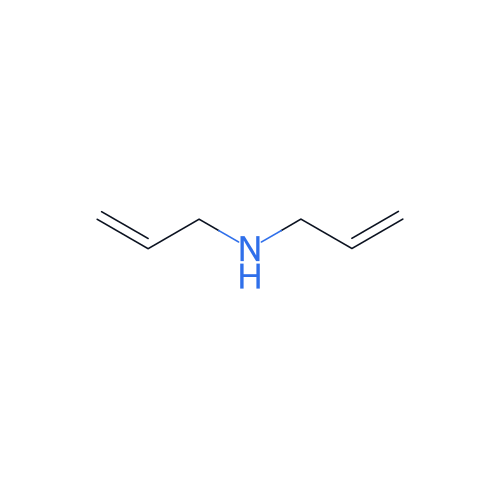
Also known as n-2-Propenyl-2-propen-1-amine, N,N-Di(2-propenyl)amine, (CH2=CHCH2)2NH
Key facts
What buyers check first
- Appearance
- Liquid
- Melting point
- -88.4 °C
- Boiling point
- 111 °C
- Density
- Relative density (water = 1): 0.8
- Flash point
- 7 °C
- HS code
- 292119
- Category
- Pharmaceutical intermediates
- UN number
- UN 2359

What is Diallylamine?
Plain description, key identifiers and synonyms
Diallylamine appears as a liquid with a disagreeable odor. Less dense than water. May be toxic by inhalation and skin absorption. Irritates skin and eyes. Used to make other chemicals.
Identifiers
Registry numbers, names and line notations, tap to copy
- IUPAC name
- N-prop-2-enylprop-2-en-1-amine
- CAS number
- 124-02-7 CAS number cross-checkedOther or deprecated CAS: 62238-80-6
- EC number
- 204-671-2
- Molecular formula
- C6H11N
- UNII
- N18EXB6V6P
- MDL number
- MFCD00008642
- InChIKey
- DYUWTXWIYMHBQS-UHFFFAOYSA-N
- InChI
- InChI=1S/C6H11N/c1-3-5-7-6-4-2/h3-4,7H,1-2,5-6H2
- SMILES (canonical and isomeric)
- C=CCNCC=C
Synonyms
- n-2-Propenyl-2-propen-1-amine
- N,N-Di(2-propenyl)amine
- (CH2=CHCH2)2NH
- 4-04-00-01060 (Beilstein Handbook Reference)
- UN 2359
- Di2propenylamine
- Amine, diallyl
- N2Propenyl2propen1amine
- 2Propen1amine, N2propenyl
- 2-Propen-1-amine, N-2-propenyl-
- Di-2-propenylamine
- bis(prop-2-en-1-yl)amine
- N-prop-2-enylprop-2-en-1-amine
- 2-Propen-1-amine, N-2-propen-1-yl-
- diprop-2-enylamine
- Amine, diallyl-
- N-allylprop-2-en-1-amine
- diallyl amine
- diallyl-amine
- bis(allyl)amine
- di-allyl amine
- N,N-Diallylamine
- N,N-diallyl amine
- Diallylamine, 99%
- N,N-Diallylamine #
Show all 29 synonymsShow fewer synonyms
- prop-2-ene, 1-allylamino-
- N-(Prop-2-en-1-yl)prop-2-en-1-amine
- Diallylamine [UN2359] [Flammable liquid]
- Diallylamine Solution in Acetonitrile, 1000ug/mL
Physical and chemical properties
Measured values and descriptors computed from the structure
Physical and chemical properties
Measured values, check the supplier specification for your grade
| Appearance | Liquidexp.Measured value |
|---|---|
| Odour | RECOGNIZABLE BUT REFRESHING ODOR @ 4-9 PPMexp.Measured value |
| Taste | SWEETISH TASTEexp.Measured value |
| Melting point | -88.4 °Cexp.Measured value |
| Boiling point | 111 °Cexp.Measured value |
| Density | Relative density (water = 1): 0.8exp.Measured value |
| Flash point | 7 °Cexp.Measured value |
| Autoignition temperature | 273 °Cexp.Measured value |
| Solubility | In water, 8.6 × 10⁺⁴ mg/l @ room temperatureexp.Measured value |
| Vapour pressure | 20.2 mm Hg @ 25 °Cexp.Measured value |
Values vary by grade. Ask suppliers for the COA or TDS of the batch you buy.
Computed descriptors
Calculated from the structure, useful for screening and formulation
| Molecular weight | 97.16 g/molcalc.Computed value |
|---|---|
| Exact mass | 97.0891 Dacalc.Computed value |
| LogP (octanol/water) | 0.95calc.Computed value |
| Topological polar surface area | 12.03 Ųcalc.Computed value |
| Hydrogen bond donors | 1calc.Computed value |
| Hydrogen bond acceptors | 1calc.Computed value |
| Rotatable bonds | 4calc.Computed value |
| Heavy atoms | 7calc.Computed value |
| Rings | 0calc.Computed value |
| Aromatic rings | 0calc.Computed value |
| Fraction sp3 carbons | 0.33calc.Computed value |
| Formal charge | 0calc.Computed value |
| Stereocentres | 0calc.Computed value |
| Lipinski rule of five | Passes (0 violations)calc.Computed value |
Calculated for screening. Confirm critical figures with the supplier.
Safety and hazards
GHS classification summary, not a safety data sheet
Hazard statements
- H225Highly flammable liquid and vapour.
- H302Harmful if swallowed.
- H311Toxic in contact with skin.
- H314Causes severe skin burns and eye damage.
- H315Causes skin irritation.
- H319Causes serious eye irritation.
- H331Toxic if inhaled.
- H332Harmful if inhaled.
- H335May cause respiratory irritation.
- H412Harmful to aquatic life with long lasting effects.
Precautionary statements (38)
- P210Keep away from heat, hot surfaces, sparks, open flames and other ignition sources. No smoking.
- P233Keep container tightly closed.
- P240Ground and bond container and receiving equipment.
- P241Use explosion-proof electrical, ventilating and lighting equipment.
- P242Use non-sparking tools.
- P243Take action to prevent static discharges.
- P260Do not breathe dust, fume, gas, mist, vapours or spray.
- P261Avoid breathing dust, fume, gas, mist, vapours or spray.
- P262Do not get in eyes, on skin, or on clothing.
- P264Wash skin thoroughly after handling.
- P264 + P265Wash skin thoroughly after handling. Do not touch eyes.
- P270Do not eat, drink or smoke when using this product.
- P271Use only outdoors or in a well-ventilated area.
- P273Avoid release to the environment.
- P280Wear protective gloves, protective clothing, eye protection and face protection.
- P301 + P317If swallowed: Get medical help.
- P301 + P330 + P331If swallowed: Rinse mouth. Do not induce vomiting.
- P302 + P352If on skin: Wash with plenty of water.
- P302 + P361 + P354If on skin: Take off immediately all contaminated clothing. Immediately rinse with water for several minutes.
- P303 + P361 + P353If on skin (or hair): Take off immediately all contaminated clothing. Rinse skin with water or shower.
- P304 + P340If inhaled: Remove person to fresh air and keep comfortable for breathing.
- P305 + P351 + P338If in eyes: Rinse cautiously with water for several minutes. Remove contact lenses, if present and easy to do. Continue rinsing.
- P305 + P354 + P338If in eyes: Immediately rinse with water for several minutes. Remove contact lenses, if present and easy to do. Continue rinsing.
- P316Get emergency medical help immediately.
- P317Get medical help.
- P319Get medical help if you feel unwell.
- P321Specific treatment (see supplemental first aid instructions on the label).
- P330Rinse mouth.
- P332 + P317If skin irritation occurs: Get medical help.
- P337 + P317If eye irritation persists: Get medical help.
- P361 + P364Take off immediately all contaminated clothing. And wash it before reuse.
- P362 + P364Take off contaminated clothing. And wash it before reuse.
- P363Wash contaminated clothing before reuse.
- P370 + P378In case of fire: Use appropriate media to extinguish.
- P403 + P233Store in a well-ventilated place. Keep container tightly closed.
- P403 + P235Store in a well-ventilated place. Keep cool.
- P405Store locked up.
- P501Dispose of contents and container in accordance with local regulations.
- UN number
- UN 2359
- Transport hazard class
- 3
- Packing group
- II
GHS classification summary, not a safety data sheet (SDS). Classifications can differ by supplier, grade and concentration. Always check the supplier's SDS.
Full safety data and first aidDiallylamine suppliers
Sponsored listings first, then the documented ranking: membership, verification, replies, completeness, freshness and ratings
- United KingdomUnclaimed profileDiallylamineGrade, purity and minimum order on requestPrice on request
- China, Cn ManufacturerUnclaimed profileDiallylamineGrade, purity and minimum order on requestPrice on request
- China ManufacturerUnclaimed profileDiallylamineGrade, purity and minimum order on requestPrice on request
- China ManufacturerUnclaimed profileDiallylamineGrade, purity and minimum order on requestPrice on request
- China, ShaoxingUnclaimed profileDiallylamineGrade, purity and minimum order on requestPrice on request
- China, Guangzhou ManufacturerUnclaimed profileDiallylamineGrade, purity and minimum order on requestPrice on request
- ChinaUnclaimed profileDiallylamineGrade, purity and minimum order on requestPrice on request
- United States ManufacturerUnclaimed profileDiallylamineGrade, purity and minimum order on requestPrice on request
- China, ZhangjiagangUnclaimed profileDiallylamineGrade, purity and minimum order on requestPrice on request
- JapanUnclaimed profileDiallylamineGrade, purity and minimum order on requestPrice on request
Suppliers marked Unclaimed profile have not claimed their profile yet. They are not verified by CompoundList, their offers are price on request and details may have changed, so please confirm them with the supplier. Company representatives can claim a profile with a business email on the company's own website domain. Our team verifies each claim and sends the result by email.
Where suppliers are based
17 suppliers in 7 countries
- China7
- United States3
- Canada2
- Germany1
- United Kingdom1
- Japan1
- and 1 more countries
Send one request to many suppliers
Choose up to 10 suppliers or let us match your request. Compare quotes side by side, free.
Diallylamine price
Indicative price range per kg from live supplier offers
Suppliers quote this chemical on request. Send one free request and compare quotes side by side.
Uses and applications
What the substance is used for, by industry and function
Intermediate in the production of pharmaceuticals and resins.
Used in crop protection and as an auxiliary in paper making.
Solvent and in organic syntheses.
Industrial uses: Intermediate.
Consumer uses: Intermediate.
How it is made
Prepared from allylamine and allyl bromide: Ladenburg, Ber. 14, 1879 (1881), from allylamine and allyl chloride: Liebermann, Hagen, Ber. 16, 1641 (1883), from diallylcyanamide by refluxing with dil sulfuric acid: Vliet, J. Am. Chem. Soc. 46, 1307 (1924), Org. Syn. coll. vol. I (2nd ed., 1941) p 201.
Prepared from allyl chloride plus ammonia (amine formation, coproduced with allylamine/triallylamine)
Regulatory status
Inventories, regulations and trade controls that list this substance
United States
- TSCA inventory (USA)Status: Active in US commerce
HS code and trade data
Customs classification and reported world trade statistics
Global trade
World import and export statistics for the HS code Diallylamine is traded under.
Acyclic monoamines and their derivatives, salts thereof, other
- China35.5%
- United States17.9%
- Germany16.4%
- United States14.1%
- South Korea9.7%
- Japan8.4%
The HS code shown for Diallylamine is indicative (it was assigned by structure rules). Confirm the classification with your customs broker before shipping.
Related chemicals
Parent and salt forms, stereoisomers, similar structures and isomers
Salt and hydrate forms
Records that share this compound as their parent
Stereoisomers and isotopic forms
Same connectivity, different stereochemistry or isotopes (same InChIKey skeleton)

Frequently asked questions
Quick answers about Diallylamine, based on the data on this page
What is Diallylamine?
What is the CAS number of Diallylamine?
What is the molecular formula and weight of Diallylamine?
What is Diallylamine used for?
Is Diallylamine hazardous?
What is the HS code of Diallylamine?
Where can I buy Diallylamine?
What is the price of Diallylamine?
Guides for buyers
Practical guides that help when you source, ship or handle Diallylamine
- Article, QualityPharma grades explained: IP vs BP vs USP vs EPWhat the Indian, British, US and European pharmacopoeias are, how their monographs differ, what multi grade claims mean and why a grade alone does not make a product fit for medicines.Read
- Guide, SafetyHow to read a safety data sheet in 10 minutesA section by section method to pull the essentials out of any 16 section SDS: identity, hazards, composition, storage, PPE, properties, transport and emergency measures.Read
- Guide, Trade and logisticsShipping dangerous goods: UN numbers, classes and packing groupsHow the UN dangerous goods system works for chemicals, from the nine classes and UN numbers to packing groups, UN packaging marks, labels, documents and segregation.Read
Get quotes for Diallylamine
Embed this structure on your websiteShow code
Paste this code into your page to show the 2D structure of Diallylamine with a 3D view, its CAS number where known and a link back to this page. Free to use with the link kept.
<iframe src="https://www.compoundlist.com/embed/structure/diallylamine-124-02-7" title="Diallylamine structure on CompoundList" width="360" height="420" style="border:1px solid #E7E2DA;border-radius:12px;max-width:100%" loading="lazy" referrerpolicy="strict-origin-when-cross-origin"></iframe>Explore more in Pharmaceutical intermediates or HS code 292119