Agrochemicals and fertilisers
Imidacloprid vs thiamethoxam
Imidacloprid (C9H10ClN5O2, CAS 138261-41-3) and thiamethoxam (C8H10ClN5O3S, CAS 153719-23-4) are both listed under insecticides and acaricides.
Imidacloprid has a molar mass of 255.67 g/mol, thiamethoxam 291.72 g/mol.
Measured melting points are 144 °C for imidacloprid and 139.1 °C for thiamethoxam.
Imidacloprid carries the GHS signal word Danger, thiamethoxam Warning.
On CompoundList, 288 suppliers list imidacloprid and 142 suppliers list thiamethoxam.
Data last updated 7 October 2026
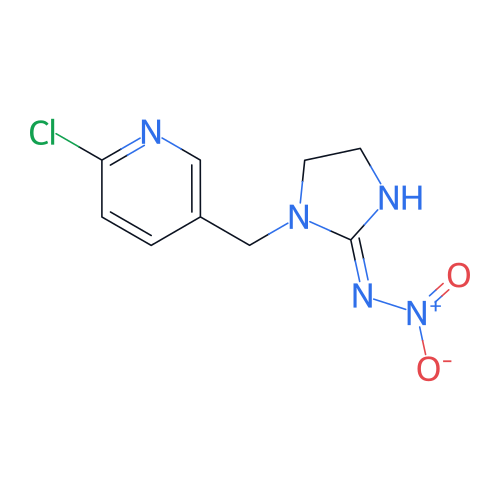 | 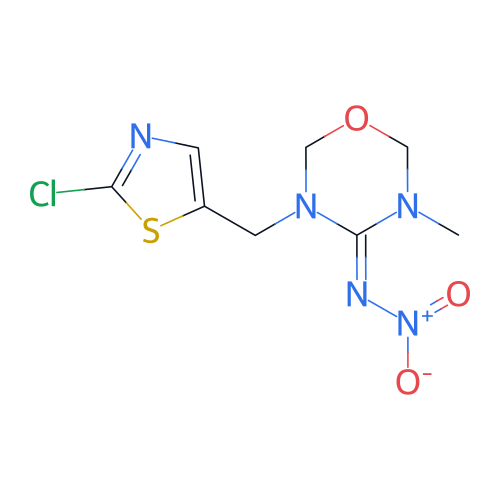 | |
|---|---|---|
| Identity | ||
| Name in our database | Imidacloprid | Thiamethoxam |
| CAS number | 138261-41-3 | 153719-23-4 |
| Molecular formula | C9H10ClN5O2 | C8H10ClN5O3S |
| Molar mass | 255.67 g/mol | 291.72 g/mol |
| IUPAC name | (NE)-N-[1-[(6-chloro-3-pyridinyl)methyl]imidazolidin-2-ylidene]nitramide | (NE)-N-[3-[(2-chloro-1,3-thiazol-5-yl)methyl]-5-methyl-1,3,5-oxadiazinan-4-ylidene]nitramide |
| EC number | 428-040-8 | 428-650-4 |
| Physical properties | ||
| Appearance | Colorless crystals | Crystalline powder |
| Melting point | 144 °C | 139.1 °C |
| Density | 1.54 g/cm³ | 1.57 at 20 °C |
| Solubility | In water, 6.1 × 10⁺² mg/L at 20 °C | In water, 4.1 × 10⁺³ mg/L at 25 °C |
| LogP (octanol/water)Computed from the structure | 0.69 | 1.02 |
| Safety (GHS) | ||
| Signal word | Danger | Warning |
| Pictograms | ||
| Hazard statements |
|
|
| UN number | UN 2588 | Not recorded |
| Uses and classification | ||
| Uses and functions |
|
|
| Category | Agrochemicals › Insecticides and acaricides | Agrochemicals › Insecticides and acaricides |
| HS code | 293339Compounds containing an unfused pyridine ring (whether or not hydrogenated) in the… | 293410Compounds containing an unfused thiazole ring (whether or not hydrogenated) in the… |
| Market on CompoundList | ||
| Suppliers | 288 suppliers | 142 suppliers |
| Supplier countries | 30 countries, most in China, Brazil, India | 19 countries, most in China, India, Brazil |
| Price rangeOnly prices set by suppliers who manage their own profile | Price on request | Price on request |
Measured and computed values as shown on each chemical page, plus live listings on CompoundList. Details may have changed, please confirm them with the supplier. Safety data is a summary, not an SDS.
More comparisons
Other common chemical pairs, compared the same way.