Phosgene
Also known as Carbonyl dichloride, Carbonic dichloride, Phosgen
Key facts
What buyers check first
- Appearance
- Colorless gas [Note: A fuming liquid below 47 degrees F. Shipped as a liquefied compress…
- Melting point
- -118 °C
- Boiling point
- 8.2 °C
- Density
- Density at critical point: 0.52 g/cm³
- Solubility
- Slightly sol in water, freely sol in benzene, toluene, glacial acetic acid, and most liq…
- HS code
- 281211
- Category
- Herbicides
- UN number
- UN 1076
What is Phosgene?
Plain description, key identifiers and synonyms
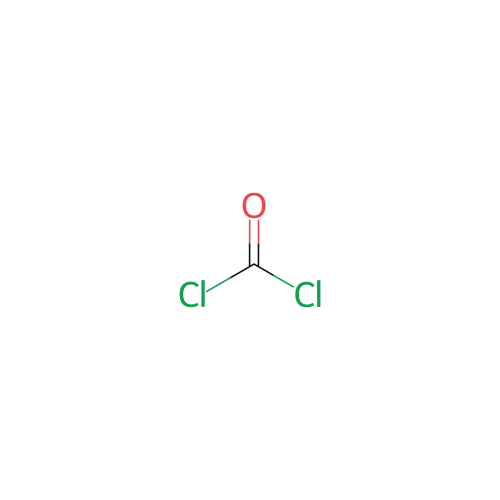
Phosgene is an acyl chloride obtained by substitution of both hydrogens of formaldehyde by chlorine. It is functionally related to a formaldehyde.
Identifiers
Registry numbers, names and line notations, tap to copy
- IUPAC name
- carbonyl dichloride
- CAS number
- 75-44-5 CAS number cross-checked
- EC number
- 200-870-3
- Molecular formula
- CCl2O
- UNII
- 117K140075
- MDL number
- MFCD00036119
- InChIKey
- YGYAWVDWMABLBF-UHFFFAOYSA-N
- InChI
- InChI=1S/CCl2O/c2-1(3)4
- SMILES (canonical and isomeric)
- C(=O)(Cl)Cl
Synonyms
- Carbonyl dichloride
- Carbonic dichloride
- Phosgen
- Carbon oxychloride
- Chloroformyl chloride
- Carbonic chloride
- Carbonylchlorid
- Fosgeen
- Fosgen
- Carbon dichloride oxide
- Carbonic acid dichloride
- Dichloroformaldehyde
- Fosgene
- Carbone (oxychlorure de)
- Combat gas
- Koolstofoxychloride
- RCRA waste number P095
- Carbonio (ossicloruro di)
- carbonyl dichloride, phosgene
- Carbonyl chloride
- chloroketone
- UN 1076
- CCl2O
- RCRA waste no. P095
- dichloroketone
Show all 27 synonymsShow fewer synonyms
- carbonylchloride
- chloro ketone
Physical and chemical properties
Measured values and descriptors computed from the structure
Physical and chemical properties
Measured values, check the supplier specification for your grade
| Appearance | Colorless gas [Note: A fuming liquid below 47 degrees F. Shipped as a liquefied compressed gas]exp.Measured value |
|---|---|
| Odour | Suffocating odor, when diluted with air there is an odor reminiscent of moldy hayexp.Measured value |
| Melting point | -118 °Cexp.Measured value |
| Boiling point | 8.2 °Cexp.Measured value |
| Density | Density at critical point: 0.52 g/cm³exp.Measured value |
| Autoignition temperature | Not flammableexp.Measured value |
| Solubility | Slightly sol in water, freely sol in benzene, toluene, glacial acetic acid, and most liquid hydrocarbonsexp.Measured value |
| Vapour pressure | 1420 mm Hg at 25 °Cexp.Measured value |
Values vary by grade. Ask suppliers for the COA or TDS of the batch you buy.
Computed descriptors
Calculated from the structure, useful for screening and formulation
| Molecular weight | 98.92 g/molcalc.Computed value |
|---|---|
| Exact mass | 97.9326 Dacalc.Computed value |
| LogP (octanol/water) | 1.58calc.Computed value |
| Topological polar surface area | 17.07 Ųcalc.Computed value |
| Hydrogen bond donors | 0calc.Computed value |
| Hydrogen bond acceptors | 1calc.Computed value |
| Rotatable bonds | 0calc.Computed value |
| Heavy atoms | 4calc.Computed value |
| Rings | 0calc.Computed value |
| Aromatic rings | 0calc.Computed value |
| Fraction sp3 carbons | 0calc.Computed value |
| Formal charge | 0calc.Computed value |
| Stereocentres | 0calc.Computed value |
| Lipinski rule of five | Passes (0 violations)calc.Computed value |
Calculated for screening. Confirm critical figures with the supplier.
Safety and hazards
GHS classification summary, not a safety data sheet
Hazard statements
- H314Causes severe skin burns and eye damage.
- H330Fatal if inhaled.
Precautionary statements (16)
- P260Do not breathe dust, fume, gas, mist, vapours or spray.
- P264Wash skin thoroughly after handling.
- P271Use only outdoors or in a well-ventilated area.
- P280Wear protective gloves, protective clothing, eye protection and face protection.
- P284In case of inadequate ventilation wear respiratory protection.
- P301 + P330 + P331If swallowed: Rinse mouth. Do not induce vomiting.
- P302 + P361 + P354If on skin: Take off immediately all contaminated clothing. Immediately rinse with water for several minutes.
- P304 + P340If inhaled: Remove person to fresh air and keep comfortable for breathing.
- P305 + P354 + P338If in eyes: Immediately rinse with water for several minutes. Remove contact lenses, if present and easy to do. Continue rinsing.
- P316Get emergency medical help immediately.
- P320Specific treatment is urgent (see supplemental first aid instructions on the label).
- P321Specific treatment (see supplemental first aid instructions on the label).
- P363Wash contaminated clothing before reuse.
- P403 + P233Store in a well-ventilated place. Keep container tightly closed.
- P405Store locked up.
- P501Dispose of contents and container in accordance with local regulations.
- UN number
- UN 1076
- Transport hazard class
- 2.3
GHS classification summary, not a safety data sheet (SDS). Classifications can differ by supplier, grade and concentration. Always check the supplier's SDS.
Full safety data and first aidPhosgene suppliers
Controlled substance, listings of documented suppliers only, in the documented ranking
Phosgene is controlled. Only documented suppliers can list it, and buyers must upload a valid licence with their request. Every request is reviewed before suppliers see it.
Licensed buyers only, every enquiry is reviewed by our compliance team.
Reference: OPCW Chemical Weapons Convention Schedule 3, HS 2022 subheading 2812.11 (carbonyl dichloride (phosgene))
Our policy on controlled substancesLicensed buyers can post a request for Phosgene with their licence. Our compliance team reviews it before suppliers see it.
Phosgene price
Indicative price range per kg from live supplier offers
Suppliers quote this chemical on request. Send one free request and compare quotes side by side.
Uses and applications
What the substance is used for, by industry and function
Phosgene is primarily used in the polyurethane industry for the production of polymeric isocyanates. Phosgene is also used in the polycarbonate industry and in the manufacture of carbamates and related pesticides, dyes, perfumes, pharmaceuticals, and isocyanates.
For the prepn of many organic chemicals, as a war gas.
Intermediate, carbonylating agent.
Production of aniline dyes.
Phosgene (CG) was originally synthesized in 1812. It was used during WWI by the German army, and has since become part of the chemical arsenal of many countries including the United States. Small amounts of phosgene (CG) exist naturally in the atmosphere from the breakdown of chlorinated compounds.
Read more
Phosgene is used in the preparation and manufacture of many organic chemicals especially in the dye, pharmaceutical, herbicide, insecticide, metal ore extraction, synthetic foam, resin, polymer, and chlorinating agent industries. Phosgene (CG) may also be released from household paint removers and degreasers when they are used in the presence of heat. Phosgene (CG) is shipped as a liquefied compressed gas in steel cylinders. At low concentrations, phosgene (CG) smells like newly mown hay or green corn. At high concentrations, phosgene (CG) has a strong, suffocating, unpleasant odor. However, the odor is only detectable for a short amount of time when phosgene (CG) is initially released and should not be depended on as a reliable indicator of overexposure.
Industrial uses: Intermediate.
Consumer uses: Intermediate.
Industries and functions
Pharmacological actions
- Chemical Warfare Agents
Pharmacology
Phosgene is a synthetic formaldehyde derivative with both hydrogens substituted by chlorine. Phosgene is used in the manufacture of other chemicals, pesticides, and pharmaceuticals. It can also be used to separate ores, and has been used as a chemical warfare agent. It is characterized as a colorless to light yellow gas at room temperature and normal pressure or as a liquid under pressure or with refrigeration, with an odor of freshly cut hay. Exposure occurs by inhalation, ingestion, or contact.
How it is made
The majority of phosgene for industrial applications is made on site by the reaction of carbon monoxide and chlorine gas using an activated carbon catalyst. Phosgene may also be produced as a combustion product of carbon tetrachloride, methylene chloride, trichloroethylene, or butyl chloroformate, although these methods are not utilized industrially.
Prepn from chlorine + carbon monoxide: Whitehouse, U.S. pat. 1,231,226 (1917), Peacock, U.S. pat. 1,360,312 (1921), Bradner, U.S. pat. 1,457,493 (1923), Douthitt, U.S. pat. 2,847,470 (1958 to Texas Co.)
Prepn from carbon monoxide + nitrosyl chloride: Williams, U.S. pat. (1930 to du Pont Ammonia Corp.)
Regulatory status
Inventories, regulations and trade controls that list this substance
Phosgene is controlled. Only documented suppliers can list it, and buyers must upload a valid licence with their request. Every request is reviewed before suppliers see it.
Licensed buyers only, every enquiry is reviewed by our compliance team.
Reference: OPCW Chemical Weapons Convention Schedule 3, HS 2022 subheading 2812.11 (carbonyl dichloride (phosgene))
Our policy on controlled substancesEurope
- EU harmonised classification (CLP Annex VI)Index no: 006-002-00-8
Controls
- Chemical Weapons Convention Schedule 3
United States
- TSCA inventory (USA)Status: Active in US commerce
HS code and trade data
Customs classification and reported world trade statistics
Global trade
World import and export statistics for the HS code Phosgene is traded under.
Carbonyl dichloride (phosgene)
- United States49.6%
- Germany23.0%
- Czech Republic17.3%
- Netherlands41.0%
- France * partner reported21.5%
- Germany15.3%
* Partner reported figures, a lower bound.
The HS code shown for Phosgene is indicative (it was matched by name in the HS nomenclature). Confirm the classification with your customs broker before shipping.
Related chemicals
Parent and salt forms, stereoisomers, similar structures and isomers
Stereoisomers and isotopic forms
Same connectivity, different stereochemistry or isotopes (same InChIKey skeleton)

Similar structures
Nearest neighbours by Morgan fingerprint Tanimoto similarity


Frequently asked questions
Quick answers about Phosgene, based on the data on this page
What is Phosgene?
What is the CAS number of Phosgene?
What is the molecular formula and weight of Phosgene?
What is Phosgene used for?
Is Phosgene hazardous?
What is the HS code of Phosgene?
Can I buy Phosgene on CompoundList?
Guides for buyers
Practical guides that help when you source, ship or handle Phosgene
- Guide, SafetyHow to read a safety data sheet in 10 minutesA section by section method to pull the essentials out of any 16 section SDS: identity, hazards, composition, storage, PPE, properties, transport and emergency measures.Read
- Guide, Trade and logisticsShipping dangerous goods: UN numbers, classes and packing groupsHow the UN dangerous goods system works for chemicals, from the nine classes and UN numbers to packing groups, UN packaging marks, labels, documents and segregation.Read
- Guide, SafetyGHS pictograms, signal words and hazard statements explainedA practical guide to the nine GHS pictograms, the signal words Danger and Warning, H and P statements, and how to read a chemical label in seconds.Read
Request as a licensed buyer
Embed this structure on your websiteShow code
Paste this code into your page to show the 2D structure of Phosgene with a 3D view, its CAS number and a link back to this page. Free to use with the link kept.
<iframe src="https://www.compoundlist.com/embed/structure/phosgene-75-44-5" title="Phosgene structure on CompoundList" width="360" height="420" style="border:1px solid #E7E2DA;border-radius:12px;max-width:100%" loading="lazy" referrerpolicy="strict-origin-when-cross-origin"></iframe>Explore more in Herbicides or HS code 281211