Antimony trichloride
Also known as Antimony(III) chloride, Antimony chloride, Trichlorostibine
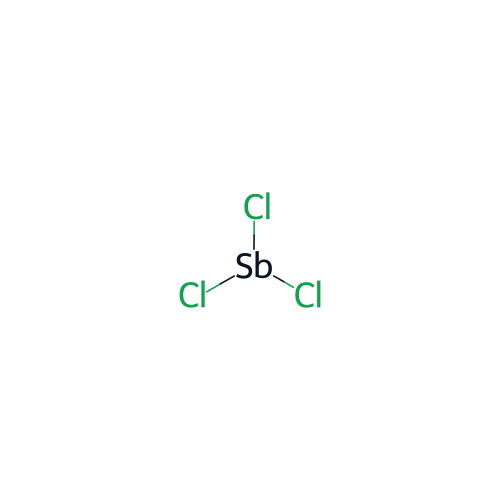
Key facts
What buyers check first
- Appearance
- Colorless orthorhombic crystals
- Melting point
- 73.4 °C
- Boiling point
- 220.3 °C
- Density
- 3.14 g/cm³
- Solubility
- In water, 987 g/100 g water at 25 °C
- HS code
- 282739
- Category
- Chlorides and other halides
- UN number
- UN 1733

What is Antimony trichloride?
Plain description, key identifiers and synonyms
Antimony trichloride is an inorganic chloride salt with formula SbCl3. It is used as a reagent for detecting vitamin A and related carotenoids, reacting with the carotenoid to form a blue complex that can be measured by colorimetry (the Carr-Price test). Solutions of antimony trichloride were formerly used for dissolving and removing horn stubs from calves and goats. It has a role as a Lewis acid, a colorimetric reagent and an apoptosis inducer. It is an inorganic chloride and an antimony molecular entity. It derives from a hydride of a stibane.
Identifiers
Registry numbers, names and line notations, tap to copy
- IUPAC name
- trichlorostibane
- CAS number
- 10025-91-9 CAS number cross-checked
- EC number
- 233-047-2
- Molecular formula
- Cl3Sb
- UNII
- J281401KK3
- InChIKey
- FAPDDOBMIUGHIN-UHFFFAOYSA-K
- InChI
- InChI=1S/3ClH.Sb/h3*1H;/q;;;+3/p-3
- SMILES (canonical and isomeric)
- Cl[Sb](Cl)Cl
Synonyms
- Antimony(III) chloride
- Antimony chloride
- Trichlorostibine
- trichlorostibane
- Stibine, trichloro-
- Antimontrichlorid
- Caustic antimony
- Antimonous chloride
- Chlorure antimonieux
- SbCl3
- Antimony(III) trichloride
- Trichlorure D'antimoine
- Antimoontrichlride
- Chlorid antimonity
- Antimony chloride (SbCl3)
- Antimony chloride (Sb2Cl6)
- Antimony trichloride (Sb2Cl6)
- Antimonio (tricloruro di)
- Antimoine (trichlorure d')
- CI 77056
- C.I. 77056
- Antimony (III) chloride
- trichloridoantimony
- Antimony trichloride, solid
- Antimony trichloride, liquid
Show all 31 synonymsShow fewer synonyms
- Antimony trichloride, solid [UN1733] [Corrosive]
- Antimony(III) chloride, ultra dry
- Antimony(III) chloride, elec. gr.
- Antimony(III) chloride, Puratronic?
- Antimony(III) chloride, p.a., 99.0%
- Antimony(III) chloride, LR, >=98.5%
Physical and chemical properties
Measured values and descriptors computed from the structure
Physical and chemical properties
Measured values, check the supplier specification for your grade
| Appearance | Colorless orthorhombic crystalsexp.Measured value |
|---|---|
| Odour | Acrid pugent odorexp.Measured value |
| Melting point | 73.4 °Cexp.Measured value |
| Boiling point | 220.3 °Cexp.Measured value |
| Density | 3.14 g/cm³exp.Measured value |
| Solubility | In water, 987 g/100 g water at 25 °Cexp.Measured value |
| Vapour pressure | 1 mm Hg at 49.2 °C (sublimes)exp.Measured value |
Values vary by grade. Ask suppliers for the COA or TDS of the batch you buy.
Computed descriptors
Calculated from the structure, useful for screening and formulation
| Molecular weight | 228.12 g/molcalc.Computed value |
|---|---|
| Exact mass | 225.8104 Dacalc.Computed value |
| LogP (octanol/water) | 1.69calc.Computed value |
| Topological polar surface area | 0 Ųcalc.Computed value |
| Hydrogen bond donors | 0calc.Computed value |
| Hydrogen bond acceptors | 0calc.Computed value |
| Rotatable bonds | 0calc.Computed value |
| Heavy atoms | 4calc.Computed value |
| Rings | 0calc.Computed value |
| Aromatic rings | 0calc.Computed value |
| Fraction sp3 carbons | 0calc.Computed value |
| Formal charge | 0calc.Computed value |
| Stereocentres | 0calc.Computed value |
Calculated for screening. Confirm critical figures with the supplier.
Safety and hazards
GHS classification summary, not a safety data sheet
Hazard statements
- H314Causes severe skin burns and eye damage.
- H411Toxic to aquatic life with long lasting effects.
Precautionary statements (14)
- P260Do not breathe dust, fume, gas, mist, vapours or spray.
- P264Wash skin thoroughly after handling.
- P273Avoid release to the environment.
- P280Wear protective gloves, protective clothing, eye protection and face protection.
- P301 + P330 + P331If swallowed: Rinse mouth. Do not induce vomiting.
- P302 + P361 + P354If on skin: Take off immediately all contaminated clothing. Immediately rinse with water for several minutes.
- P304 + P340If inhaled: Remove person to fresh air and keep comfortable for breathing.
- P305 + P354 + P338If in eyes: Immediately rinse with water for several minutes. Remove contact lenses, if present and easy to do. Continue rinsing.
- P316Get emergency medical help immediately.
- P321Specific treatment (see supplemental first aid instructions on the label).
- P363Wash contaminated clothing before reuse.
- P391Collect spillage.
- P405Store locked up.
- P501Dispose of contents and container in accordance with local regulations.
- UN number
- UN 1733
- Transport hazard class
- 8
- Packing group
- II
GHS classification summary, not a safety data sheet (SDS). Classifications can differ by supplier, grade and concentration. Always check the supplier's SDS.
Full safety data and first aidAntimony trichloride suppliers
Sponsored listings first, then the documented ranking: membership, verification, replies, completeness, freshness and ratings
- GermanyUnclaimed profileAntimony-III-chlorideGrade, purity and minimum order on requestPrice on request
- United Arab Emirates, Dubai ManufacturerUnclaimed profileAntimony trichlorideGrade, purity and minimum order on requestPrice on request
- India ManufacturerUnclaimed profileAntimony trichlorideGrade, purity and minimum order on requestPrice on request
- India ManufacturerUnclaimed profileAntimony trichlorideGrade, purity and minimum order on requestPrice on request
- India ManufacturerUnclaimed profileAntimony trichlorideGrade, purity and minimum order on requestPrice on request
- Price on request
- ManufacturerUnclaimed profileAntimony trichlorideGrade, purity and minimum order on requestPrice on request
- India, Badlapur ManufacturerUnclaimed profileAntimony trichlorideGrade, purity and minimum order on requestPrice on request
- India, MumbaiUnclaimed profileAntimony trichlorideGrade, purity and minimum order on requestPrice on request
- United StatesUnclaimed profileAntimony trichlorideGrade, purity and minimum order on requestPrice on request
Suppliers marked Unclaimed profile have not claimed their profile yet. They are not verified by CompoundList, their offers are price on request and details may have changed, so please confirm them with the supplier. Company representatives can claim a profile with a business email on the company's own website domain. Our team verifies each claim and sends the result by email.
Where suppliers are based
45 suppliers in 12 countries
- India19
- United States6
- United Arab Emirates2
- Germany2
- Italy2
- Mexico2
- and 6 more countries
Send one request to many suppliers
Choose up to 10 suppliers or let us match your request. Compare quotes side by side, free.
Antimony trichloride price
Indicative price range per kg from live supplier offers
Suppliers quote this chemical on request. Send one free request and compare quotes side by side.
Uses and applications
What the substance is used for, by industry and function
Lewis acid catalyst in organic synthesis, in making other antimony salts. As mordant, in bronzing iron.
Manufacturing lakes, ... pharmaceuticals, fireproofing textiles, analytical reagent.
Large quantities are consumed in rendering textiles, plastics, and other combustible substances flame retardant or self-extinguishing.
Used as a catalyst or as a component of catalysts to effect polymerization of hydrocarbons and to chlorinate olefins. It is also used in hydrocracking of coal and heavy hydrocarbons, as an analytical reagent for chloral, aromatic hydrocarbons and vitamin A, and in the microscopic identification of drugs. Liquid SbCl3 is used an a nonaqueous solvent.
Veterinary medication:.
Industries and functions
Roles
- Lewis acid
- acceptor
- acid
- apoptosis inducer
- colorimetric reagent
- reagent
How it is made
Prepared from the elements...
Interaction of chlorine and antimony or by dissolving antimony sulfide in hydrochloric acid.
Antimony trichloride may be prepared by chlorination of antimony metal, Sb2O3, or Sb2S3, or by reaction of Sb2O3 with concentrated HCl.
Regulatory status
Inventories, regulations and trade controls that list this substance
Europe
- EU harmonised classification (CLP Annex VI)Index no: 051-001-00-8
United States
- TSCA inventory (USA)Status: Active in US commerce
HS code and trade data
Customs classification and reported world trade statistics
Global trade
World import and export statistics for the HS code Antimony trichloride is traded under.
Chlorides, other than of ammonium, calcium, magnesium, aluminium and nickel
- United States16.4%
- China16.3%
- Germany13.6%
- South Korea15.0%
- United States13.0%
- France * partner reported6.8%
* Partner reported figures, a lower bound.
The HS code shown for Antimony trichloride is indicative (it was assigned by structure rules). Confirm the classification with your customs broker before shipping.
Frequently asked questions
Quick answers about Antimony trichloride, based on the data on this page
What is Antimony trichloride?
What is Antimony trichloride used for?
Is Antimony trichloride hazardous?
Guides for buyers
Practical guides that help when you source, ship or handle Antimony trichloride
- Guide, SafetyHow to read a safety data sheet in 10 minutesA section by section method to pull the essentials out of any 16 section SDS: identity, hazards, composition, storage, PPE, properties, transport and emergency measures.Read
- Guide, Trade and logisticsShipping dangerous goods: UN numbers, classes and packing groupsHow the UN dangerous goods system works for chemicals, from the nine classes and UN numbers to packing groups, UN packaging marks, labels, documents and segregation.Read
- Guide, SafetyGHS pictograms, signal words and hazard statements explainedA practical guide to the nine GHS pictograms, the signal words Danger and Warning, H and P statements, and how to read a chemical label in seconds.Read
Get quotes for Antimony trichloride
Embed this structure on your websiteShow code
Paste this code into your page to show the 2D structure of Antimony trichloride with a 3D view, its CAS number where known and a link back to this page. Free to use with the link kept.
<iframe src="https://www.compoundlist.com/embed/structure/antimony-trichloride-10025-91-9" title="Antimony trichloride structure on CompoundList" width="360" height="420" style="border:1px solid #E7E2DA;border-radius:12px;max-width:100%" loading="lazy" referrerpolicy="strict-origin-when-cross-origin"></iframe>Explore more in Chlorides and other halides or HS code 282739