Cosmetic and personal care ingredients
Hydroquinone vs kojic acid
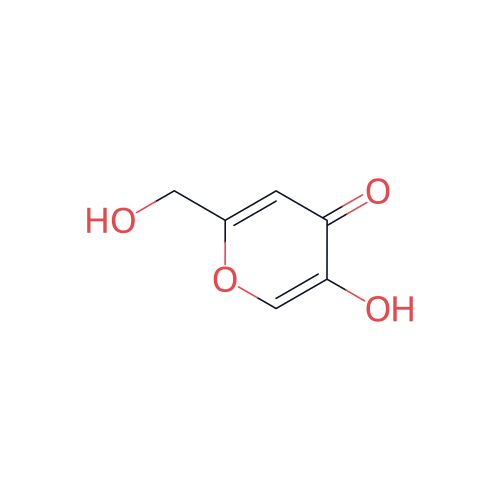
Hydroquinone (C6H6O2, CAS 123-31-9) and kojic acid (C6H6O4, CAS 501-30-4) are both listed under skin conditioning agents and actives.
Hydroquinone has a molar mass of 110.11 g/mol, kojic acid 142.11 g/mol.
Measured melting points are 170 to 171 for hydroquinone and 153.5 °C for kojic acid.
Hydroquinone carries the GHS signal word Danger, kojic acid Warning.
On CompoundList, 265 suppliers list hydroquinone and 166 suppliers list kojic acid.
Data last updated 7 October 2026
 |  | |
|---|---|---|
| Identity | ||
| Name in our database | Hydroquinone | Kojic acid |
| CAS number | 123-31-9 | 501-30-4 |
| Molecular formula | C6H6O2 | C6H6O4 |
| Molar mass | 110.11 g/mol | 142.11 g/mol |
| IUPAC name | benzene-1,4-diol | 5-hydroxy-2-(hydroxymethyl)pyran-4-one |
| EC number | 204-617-8 | 207-922-4 |
| Physical properties | ||
| Appearance | White crystals | Prismatic needles from acetone, ethanol+ether or methanol+ethyl acetate |
| Melting point | 170 to 171 | 153.5 °C |
| Boiling point | 285 to 287 | Not recorded |
| Density | 1.330 g/cm³ at 20 °C | Not recorded |
| Flash point | 165 °C | Not recorded |
| Solubility | In water, 72,000 mg/L at 25 °C | Soluble in water, acetone, slightly solluble in ether, insoluble in benzene |
| LogP (octanol/water)Computed from the structure | 1.1 | -0.16 |
| Safety (GHS) | ||
| Signal word | Danger | Warning |
| Pictograms | ||
| Hazard statements |
|
|
| UN number | UN 2662 | Not recorded |
| Uses and classification | ||
| Uses and functions |
|
|
| Category | Cosmetic ingredients › Skin conditioning agents and actives | Cosmetic ingredients › Skin conditioning agents and actives |
| HS code | 290722Hydroquinone (quinol) and its salts | 293299Heterocyclic compounds with oxygen hetero-atom(s) only, other |
| Market on CompoundList | ||
| Suppliers | 265 suppliers | 166 suppliers |
| Supplier countries | 34 countries, most in China, United States, India | 24 countries, most in China, United States, India |
| Price rangeOnly prices set by suppliers who manage their own profile | Price on request | Price on request |
Measured and computed values as shown on each chemical page, plus live listings on CompoundList. Details may have changed, please confirm them with the supplier. Safety data is a summary, not an SDS.
More comparisons
Other common chemical pairs, compared the same way.